
Toxic IAM Combinations in AWSThe Hidden Risk Behind Individual Permissions
Some AWS permissions may not look dangerous when reviewed separately. But when they are combined, they can create privilege escalation, data exposure, security control bypass, and cloud takeover paths. IAM security cannot stop at checking individual policies.
In AWS, the real risk is often not one permission. It is the combination.
Best for AWS architects, cloud security teams, DevSecOps, SaaS founders, MSPs, compliance teams, and security-conscious engineering leaders.
Listen to the Podcast
Episode length: 23 minutes · Toxic IAM permission combinations, privilege escalation & blast radius
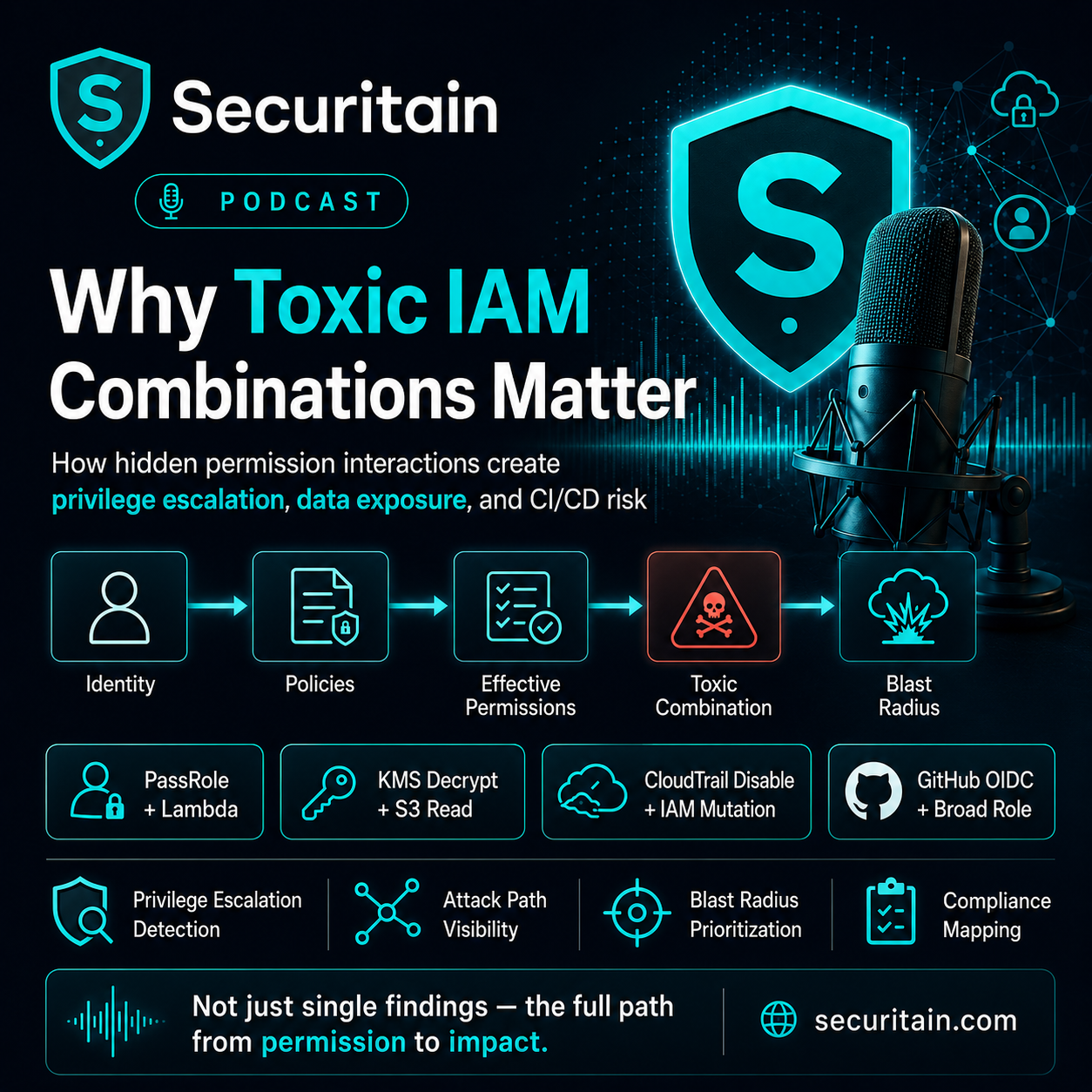
AWS IAM risk is rarely isolated
A user with one permission may not look risky. A role with one trust policy may not look critical. A policy with one broad action may not seem urgent. But when those permissions interact, they can create hidden security paths.
- →iam:PassRole plus Lambda creation can become privilege escalation.
- →kms:Decrypt plus S3 read access can become sensitive data exposure.
- →CloudTrail disablement plus IAM mutation can hide attacker activity.
- →GitHub OIDC trust plus broad role permissions can expose production deployment paths.
- →Resource policy access plus cross-account trust can create external exposure.
Why Toxic IAM Combinations Matter
Most reviews focus on single findings
- “This access key is old.”
- “This policy has wildcard access.”
- “This role has external trust.”
- “This user does not have MFA.”
- “This bucket policy allows external access.”
Those findings matter — but they do not always tell the full story.
The bigger question
What can this identity actually do when all permissions, roles, trust policies, resource policies, and inherited access are combined?
An identity may not be admin today — but it may become admin through a chain of allowed actions. This is the risk behind the risk.
Ten Toxic IAM Combinations Securitain Detects
PassRole + Lambda Create/Update
If a user can pass a powerful role to a Lambda function and control the function code, that user may be able to execute actions with the permissions of the passed role.
Why it matters: The identity may not be admin directly, but it may be able to run code as a more privileged role.
PassRole + EC2 RunInstances
If a principal can launch EC2 instances and pass an instance profile, they may be able to gain access to the permissions attached to that instance profile.
Why it matters: This can become a route from limited permissions to broader infrastructure or data access.
PassRole + ECS RunTask
ECS tasks often run with task roles. If a principal can run tasks and pass privileged task roles, the principal may indirectly use those role permissions.
Why it matters: A deployment or automation identity may become a privilege escalation path.
KMS Decrypt + S3 Read Access
S3 read access alone may not be enough if objects are encrypted. KMS decrypt alone may not be enough without access to the data. Together, they can expose sensitive information.
Why it matters: This combination can create real data exfiltration risk.
SecretsManager Read + Compute Execution
A role that can read secrets is sensitive. A role that can modify compute workloads is also sensitive. Together, they may allow an attacker to inject code, read secrets, and move deeper.
Why it matters: Secrets can become the bridge from one system to another.
CloudTrail StopLogging + IAM Mutation
If a principal can change IAM permissions and also disable or weaken logging, the risk becomes much higher.
Why it matters: An attacker may be able to escalate access and reduce visibility at the same time.
GuardDuty / SecurityHub Disable + Privilege Escalation
If an identity can disable detection services and also escalate permissions, it becomes a high-risk identity.
Why it matters: The attacker may be able to both increase access and reduce detection.
GitHub OIDC Trust + Broad Production Role
If the trust policy is too broad, it can allow unexpected workflows, branches, or repositories to assume sensitive AWS roles — missing audience/subject conditions, wildcard repos, all-branches, or PR workflows for production.
Why it matters: A CI/CD trust policy can become a production access path.
S3 Policy Modification + S3 Read/Write
If a principal can modify bucket policies and also has data access, it may be able to expose or manipulate data paths.
Why it matters: The risk is not only what the user can read now. It is what the user can make accessible later.
IAM Policy Version Control + Set Default Version
Some IAM permissions allow a principal to create a new policy version and set it as default — privilege escalation if it can modify a policy attached to itself or another powerful identity.
Why it matters: The user may be able to change permissions without directly attaching a new policy.
Why Normal Dashboards Miss This
Many dashboards show alerts as separate rows. That helps with visibility, but it often misses relationships. Securitain is designed to ask deeper questions:
This is the difference between alert volume and security understanding.
Analysis across connected IAM layers
Effective Permissions
Evaluates what each identity can actually do after direct policies, group inheritance, inline policies, permission boundaries, SCPs, resource policies, explicit denies, and conditions.
Privilege Escalation Detection
Finds paths where a user or role can gain more power than it appears to have — PassRole abuse, policy version manipulation, trust modification, key creation, and compute execution-role abuse.
Toxic Combination Analysis
Identifies dangerous combinations that create hidden attack paths — and explains why the combination matters, not just which permissions are risky.
Blast Radius Calculation
Prioritizes findings by impact: if an identity is compromised, what can it reach — admin, sensitive S3, KMS keys, secrets, Lambda, other accounts, security services, production?
Attack Path Visibility
Connects identities, roles, policies, trust relationships, resources, and findings into a graph-style view so teams understand how risk moves across the environment.
Compliance Mapping
Maps findings to frameworks such as CIS AWS Foundations, SOC 2, NIST, HIPAA, PCI DSS, and AWS Well-Architected.

From Simple Finding to Real Risk
A role has iam:PassRole.
- Which roles can it pass?
- Can it create Lambda / launch EC2 / run ECS?
- Can it create CloudFormation stacks?
- Are any passable roles privileged?
- Is this role used by CI/CD? Is trust broad?
- Can it reach production?
Can this identity become more powerful than it appears?
That is the question Securitain is built to answer.
Why This Matters for Leadership
Toxic IAM combinations create business risk because they are hard to see manually. They can lead to data exposure, privilege escalation, compliance failures, production compromise, undetected attacker activity, unsafe CI/CD access, and audit gaps.
For leaders, the value is prioritization — identify which issues create the highest real-world risk instead of chasing hundreds of findings.
Why This Matters for Engineers
- Which policy statement caused the risk
- Which role or user is affected
- Which permissions combine dangerously
- Which resource is reachable
- Whether the issue is critical, high, medium, or low
- What remediation path is safest
- Whether the fix should be reviewed before applying
What's inside the 23 minutes
Why IAM Risk Is Often Hidden
Why AWS IAM risk is not always visible from individual permissions.
What Toxic IAM Combinations Mean
How permissions that appear acceptable separately can become dangerous together.
Privilege Escalation Paths
iam:PassRole, Lambda, EC2, ECS, CloudFormation, and policy mutation risks.
Data Exposure Combinations
How S3 read, KMS decrypt, secrets access, and resource policies combine into exposure.
CI/CD and OIDC Trust Risk
Why GitHub OIDC, deployment roles, branch conditions, and wildcard trust need review.
Blast Radius and Prioritization
Why teams should fix identities with the highest business impact first.
How Securitain Approaches the Problem
Connecting effective permissions, toxic combinations, attack paths, blast radius, and compliance.
Final Takeaway
The real danger is often not one permission — it is what that permission can do when combined.
How Toxic IAM Combinations Become Attack Paths

Securitain is designed to connect the dots across IAM and AWS security posture so teams can understand the full path from permission to impact.
Toxic IAM combinations, explained
A set of permissions, trust relationships, or resource access patterns that become dangerous when used together.
Find the Risk Behind the Permission
Securitain helps teams understand toxic IAM combinations, privilege escalation paths, blast radius, cross-account exposure, and compliance impact — so they can fix the issues that matter most.
Securitain is built to help teams move from IAM visibility to IAM understanding. Because in AWS security, the question is not only “What permissions exist?” — the real question is “What can those permissions become?”